Chilli Farming Information Guide:
The following write-up details about Chilli Farming/Planting Methods of Chilli, Pepper Farming Practices.
Introduction:
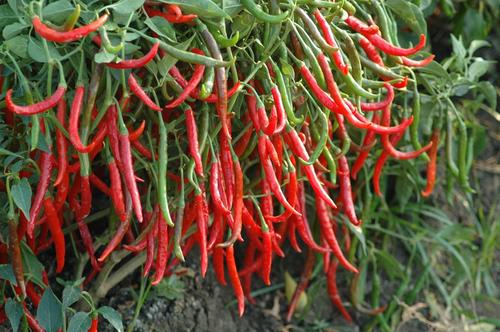
Chilli is one of the most valuable crops in India. The crop is grown largely for its fruits all over India. It is used in India as a principal ingredient of various curries, and chutneys. It is also used for vegetables, spices, condiments, sauces, and pickles. Dry Chillies are used for curry powder. The red color in chili is due to “Capsanthin”. Pungency in Chillies is due to the active constituent “Capsaicin”, an alkaloid is extracted from Chillies and is used to the medicine.
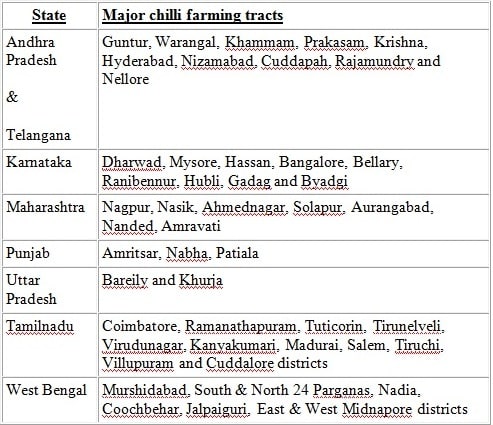
Major Chilli farming tracts in India:
Climate requirement of Chilli Cultivation:
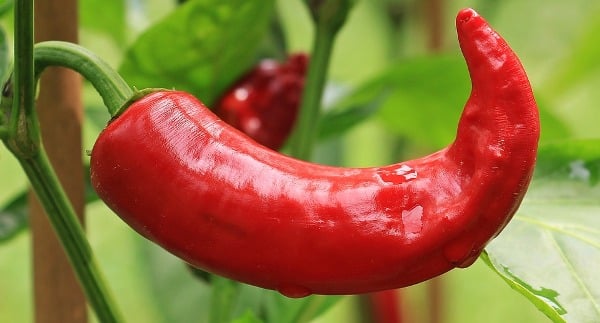
The chili is a plant of a tropical and subtropical region -It grows well in warm and humid climate and a temperature of 20-25°C. Low moisture in the soil during blossom development and fruit formation causes the bud, deblossom and fruit drops. Excessive rainfall is detrimental to the crops because it brings about defoliation and rotting of the plant. As a rained crop, it is grown in areas receiving annual precipitation of 25-30 inches.
Best Soil for growing Chillies or Peppers
Chilli can be grown in a range of soils, but black soils which retain moisture for long periods are suitable for rainfed crop whereas well-drained soils, deltaic soils, and sandy loams are good under irrigated condition. However, in hills of Uttarakhand, Chilli is grown in a wide range of soils ranging from sandy to clay loam mixed with gravel and coarse sand.
Maintenance of the buffer zone in Pepper Production
In the organic Chilli farming, a buffer zone of 7.5 – 15 m is to be left all around the conventional farm, depending upon the location of the farm. The produce from this buffer zone shall not be treated as organic.
Read: How To Grow Vegetables in the Balcony.
Land Preparation for Growing Chillies:
Chilli can be grown in all type of soft but the sandy – loam, clay loam and loam soils are best suited for it, the soil must be well drained and well aerated. Acidic soils are not suitable for chili cultivation.
The land is prepared by giving 2-3 ploughings and clod crushing after each plowing. Compost or FYM @ 150-200 quintals should be spread and mixed well in the soil at least 15-20 days before sowing. At the last plowing, 0. H. C. @ 8-10 kg per acre of Aldrin or Heftaf @ 10-15 kg per acre should be applied to the soil to protect the crop from white ants and other soil pests.
Planting material/Propagation of Chilli or Pepper
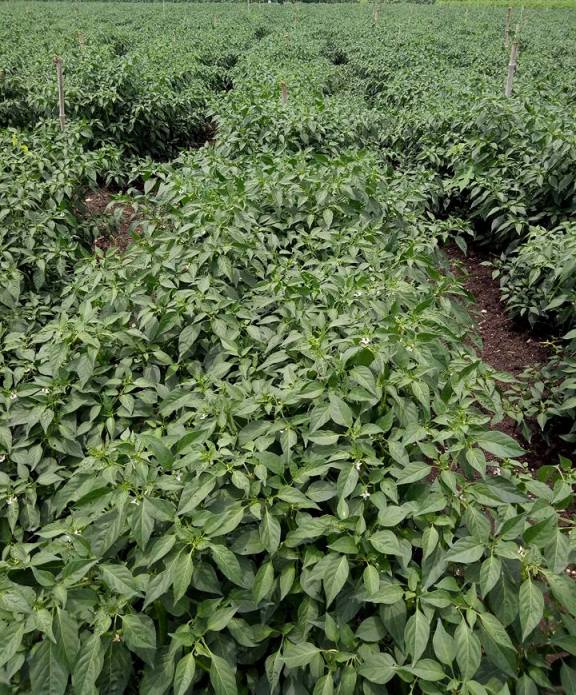
Chilli is propagated by seeds. For raising nurseries, seeds of high yielding varieties with tolerance to pests and diseases may be used. They should be carefully selected from certified organic farms or from own seed plot which is raised organically. To start with, chemically untreated seeds from local high yielding varieties could also be used, in the absence of organically produced seeds.
Varieties of Chillies:
Pusa Sadabahar, Pusa Jwala, and Pant C-1 are the Chilli varieties for cultivation in Uttarakhand. However, many of the farmers are growing varieties procured from Pantnagar for long and even using their own seeds.
Sowing Time and Seed Rate of Chillies
In the case of Chilli crop, for Khari, it is sown in May – June and for the summer crop, it is sown in the month of January. 1 to 1 1/2 kg seed is required for 1 hectare of area.
Seed Treatment of Chilli
Seeds should not be treated with any chemical fungicides or pesticides in Chiili Farming. However, it is always beneficial to adopt indigenous practices for seed treatment, wherever possible. The seeds may be treated with Trichoderma and Psuedomonas sp. @ 10 g per kg of seed to prevent the incidence of seedling rot in the nursery. The ideal time for raising nursery is February – March in the hills of Uttarakhand. Transplanting would be done during the months of April – May. 400 g of seeds would be sufficient for raising nursery for transplantation in an area of an acre.
Nursery Raising Chillies:
Fresh Chilli seeds are sown in well-prepared nursery beds. Although it can be sown by the broadcast method in the main field, transplanting method is preferred for better quality and survival. The nursery bed is usually raised from ground level and is prepared by thorough mixing with compost and sand. Seeds treated with Trichoderma are sown and covered thinly using sand. The seeds germination time is 5 to 7 days. About 40 – 45 days old seedlings are transplanted in the actual field.

Spacing and Plantation of Chillies:
40-45 days old seedlings are used for transplantation. Transplanting is generally done during the April-May in the hills of Uttarakhand. Seedlings are transplanted in shallow trenches/pits or on ridges/level lands. In some places, 60 cm x 60 cm or 45 cm x 30 cm or 30 cm x 30 cm spacing is also followed. However, a spacing of 60 cm x 30 cm with a plant population of about 22200 seedlings per acre or 45 cm x 45 cm with a plant population of 19750 per acre are considered optimum.
Direct Sowing of Chilli:
Direct sowing is practiced under rainfed conditions. For direct sown crop, the seeds are drilled by the end of March or first week of April. Seed rate is 2.5-3.0 kg per acre. After 30-40 days of sowing, thinning and gap filling is done on a cloudy day.
Irrigation requirement for Chilli Plants:
Chilli cannot withstand heavy moisture. Hence irrigation should be given only when necessary. Frequent and heavy irrigation induces lanky vegetative growth and causes flower shedding. Plant growth, branching, and dry matter accumulation are adversely affected by excess irrigation. The number of irrigation and interval between irrigation depends on soil and climatic conditions. If the plants show drooping of leaves at 4 p.m., it is an indication that irrigation is needed. Flowering and fruit development in Chilli are the most critical stages of water requirement. Normally Chilli is grown under rain-fed condition. However, under the irrigated condition, care should be taken to avoid using water contaminated with fertilizers, pesticides, and fungicides. Irrigation should be done judiciously. Stagnation of water should not be allowed in nursery beds and fields in order to avoid fungal infection.
Read: Okra Farming Cost; Profits.
Intercultural operations/Weed Control/Pruning of Chilli Plants:
Seedlings raised by sowing through broadcasting method or in line in ridges should be thinned out by hand 25 to 30 days after sowing the seeds to maintain a plant population of about 30 to 60 plants/m2. The plant density to be maintained finally may depend on the nature and fertility of the soil. On marginal soil, the population is maintained high. Generally, two weedings/hoeings are required to keep the field free from weeds, the first within 20-25 days of sowing and the other after 20-25 days of the first weeding/hoeing. Wherever needed, depending on the weed growth one or two more weedings may be taken up. Weeds which attract pests should be allowed to grow in the field to act as a trap and removed before flowering. Earthing up is carried out as and when necessary. Chilli can be cultivated organically as an inter or mixed crop provided all the other crops are grown under organic methods. It is desirable to include a leguminous crop in rotation with Chilli farming.
Read: Ideas for Landscape Gardening.
Manures and Fertilizers requirement for Chilli Plants:
In Chilli Farming,10 to 11 tonnes/hectare of farmyard manure (FYM) or compost is applied at the time of field preparation. In Chilli for rained crop 50 kg, N and 25 kg P should be applied 1/2 dose of N full dose of P applied at the time of transplanting. Remaining Yi dose of N applied 30 days after transplanting for .irrigated crop 100 kg N, 50kg P & 50 kg K should be applied per hectare. Fertilizers are applied in four equal doses. First applied at the time transplanting remaining doses are applied at 4th, 111 & 13′ week after transplanting.
Insect Pest control in Pepper Farming:
Thrips, mites, aphids, root grubs, and pod borers are the major pests in Chilli farming. To avoid infestation of root grub, only well rotten farmyard manure should be applied in the field. Application of neem cake @ 100 kg/acre is advisable for control of root grubs. Change in the agronomic practices to disturb the life cycle of the grub is also found useful. To control the infestation of root grub, light traps can be laid out from March. Grass can be heaped at different places in the field and the grubs which accumulate in these heaps may be collected in the early morning and destroyed. 400 grames/acre of Beauvaria bassiana may be broadcast in the field. Transplanting before the first fortnight of April also helps in reducing the incidence of root grub.
Application of neem seed kernel extract (NSKE) can be done for control of thrips, aphids, and mites. 10 kg of neem seed kernels may be boiled in 15 l of water. 200 ml of this extract may be mixed in 15 l of water and four to five sprays may be given to control sucking pests. Farmers also use seed extracts of Bakaine (Melia azadirach) along with Bichoo Grass (Urtica dioica) for control of pests. Release of larvae of Chrysoperla cornea, a biocontrol agent, once in 15 days is also helpful in controlling thrips and mites. Fruit (pod) borers are the major pests which cause considerable damage to the crop. They can be managed to a certain extent by the adoption of biocontrol measures. Restricted installation of pheromone traps in the field @ 5 no. per acre helps to monitor the adult moths. Ten days after spotting the moths in the traps, 4-5 spraying with Nuclear Polyhedrosis Virus (NPV) @ 200 LE (larval equivalent)/acre is beneficial to control the early larval stage of the pod borers. The egg masses of Spodoptera borer can be mechanically collected and destroyed. Trichogramma, an egg parasite, may be released two days after the appearance of moths. Spraying of neem products like neem oil, neem seed kernel extract and restricted use of Bacillus thuringiensis @ 0.4 kg/acre are beneficial. All the shed fruits and part of inflorescence should be collected and destroyed at regular intervals.
Disease control of Chilli:
Fruit rot & Dieback caused by Colletotrichum capsici and bacterial wilt are the two major diseases in Chilli farming. Bacterial leaf spot, powdery mildew and mosaic disease (caused by a virus) are the major diseases of Chilli. Careful seed selection and adoption of phytosanitary measures will check the diseases of Chilli. Early removal of affected plants will control the spread of the diseases. Seed treatment with Trichoderma takes care of seedling rot in the nursery. Varieties tolerant to diseases should be used wherever the disease is severe. Rouging and destruction of affected plants help in checking the mosaic virus. For effective disease control, 10 g of Trichoderma or Pseduomonas sp. per liter of water should be used for spraying.
Growth Phases of Pepper:
The crop duration of chilli is about 150-180 days depending on variety, season and climate, fertility and water management. The growth of Chilli comprises of vegetative and reproductive phases. In general, the vegetative phase in Chilli extends to 75-85 days followed by 75-95 days of the reproductive phase. The vegetative phase is characterized by an increase in plant height with profuse branching. Heavy branching is preferred for better aeration and sunlight infiltration into the canopy over compact varieties. This also helps in preventing fruit rot. Flowering starts from 80-85 days of the crop or 40-45 days after transplanting. Chilli plant is an often cross-pollinated crop with 50% of the natural crossing. For fruit development and maturity about 40 days, time is required after anthesis and pollination.
Harvesting of Chillies:
Chilli is highly perishable in nature. It requires more attention during harvest, storage, and transportation. Harvesting should be done at the right stage of maturity.
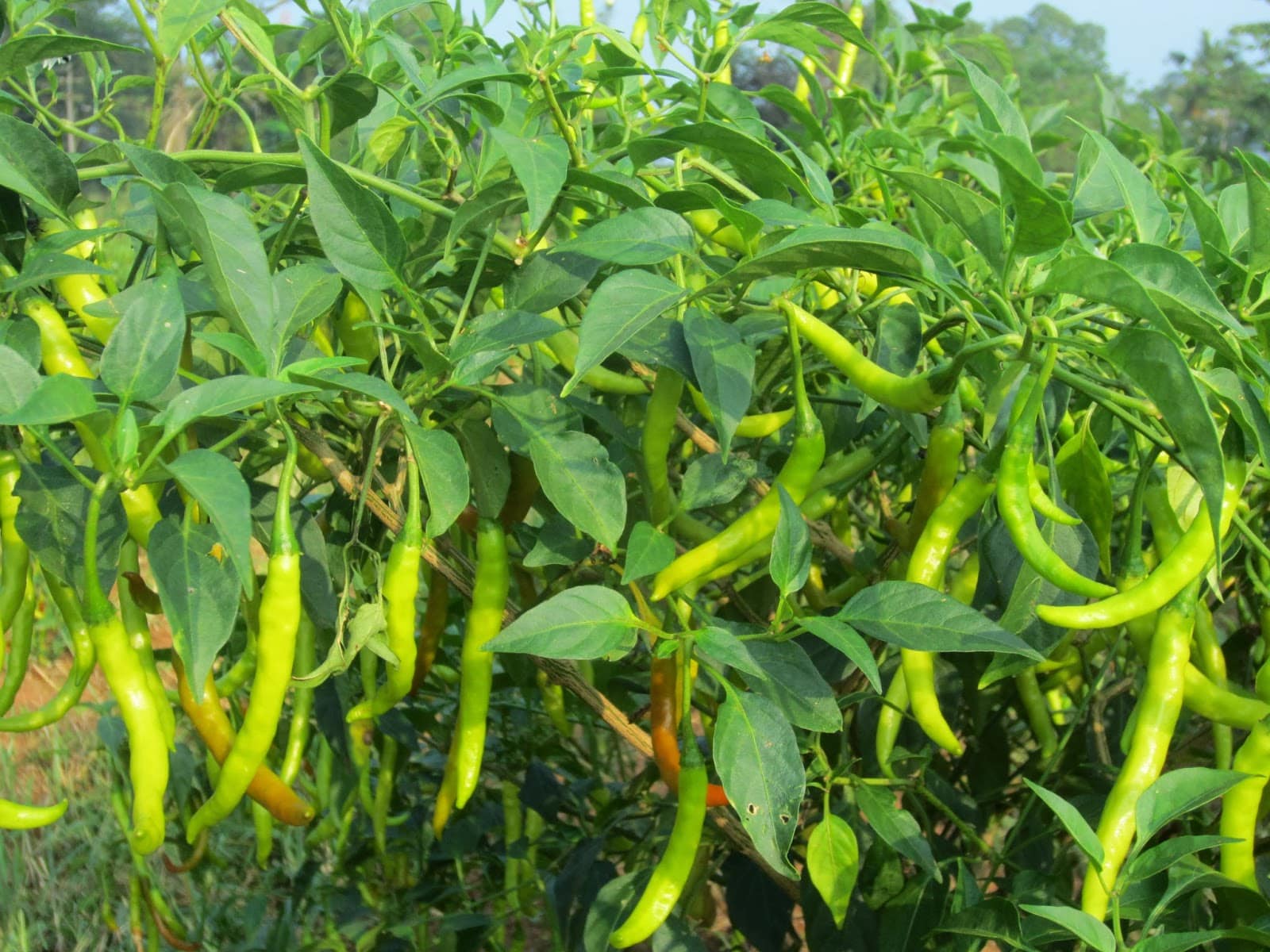
- Chillies which are used for vegetable purposes are generally harvested while they are still green but full grown.
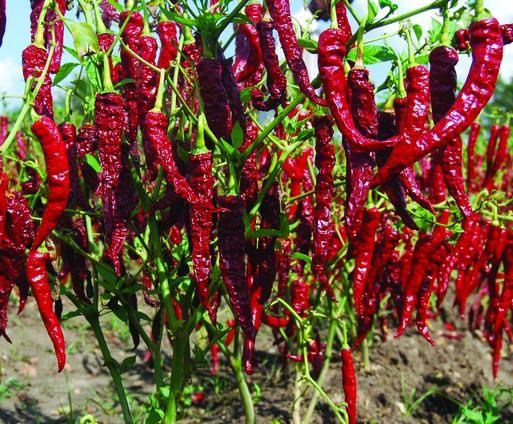
- Chillies are harvested at the red color stage for caning purpose. Chillies used for drying are harvested at full ripe-stage which can be turned into Chilli powder.
The yield of Chillies:
The yield varies according to the system of cultivation. The yield of dry Chillies of the rainfed crop is 200 – 400 kg and that of the irrigated crop is 600 – 1000 kg per acre. The proportion of dry to fresh japed Chillies varies from 25- to 40 percent.
Post-Harvesting Tasks in Chilli Farming:
This can be done in three phases.
1) Drying 2) Grading & Packing 3) Storage.
Bottom Line:
It’s spicy farming and good profits are possible with proper Chilli farming techniques.
Read: How To Grow Pearl Millet.
Interesting information and I would like to try out some chilli growing on a small scale ( 2 ha ). I live in Zambia where Chillie production is almost non existent. May I know, how I can get top yielding varieties .
Well,we are based out of India. The only way is to contact horticulture department in Zambia or search high yielding chilli seeds online.
Hey, could I get a copy of the work you have done her I love the information @agrifarming
Please get in touch with me. I have good experience and interest in co-operative working in agriculture.
Hi, I am interested in getting into chilli farming and find the information presented on this page extremely helpful. Are you able to provide this information in PDF format for people like me to print out and use as reference material?
At this point, we are not having a PDF download for farming articles or project reports.
My chilli plant leaves turning to yellow, what is the solution for this? Any idea?
Read this:Chilli Psts and Diseases.
Hi What is the Chilli yield per plant per week
1. Too much water in the roots. 2. Calcium deficit.
Chili plant yields about 2 kg of fruit throughout its productive stages. About 6 to 8 months.
How can I take more fruits form my chill plants any medicine for it
Am interested to grow chillies in zimbabwe
Great work you are doing here Mr. Reddy. Thank you
I have 3acreage of land and I would like to venture in hot pepper farming. I seeking for contract partnership?!
Hey good afternoon everyone? Am Nicholas from Zambia,, am a new chilli farmer so I need advice from every one please ,,,, am very interested